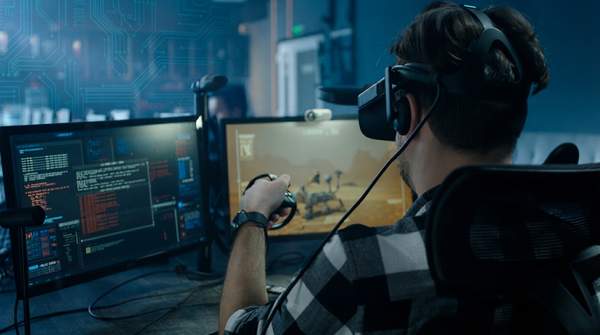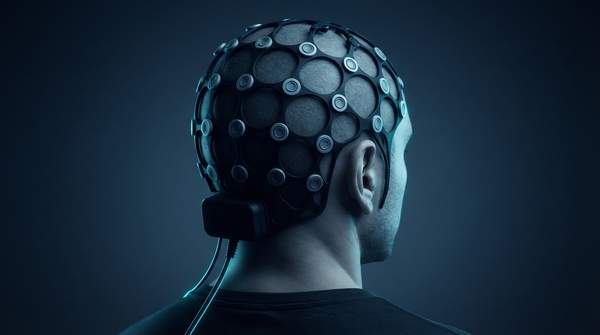
Brain-computer interfaces come in two broad flavors, and the difference between them shapes where each can realistically go. Invasive BCIs implant electrodes directly in the brain and deliver high-fidelity signals, but require surgery and carry long-term biocompatibility concerns. Non-invasive BCIs record brain activity from sensors on the scalp—most commonly via electroencephalography (EEG)—trading precision for safety and accessibility. That trade-off is why the non-invasive side of the field is where consumer and commercial applications, from gaming to smart home control to workplace cognitive tools, are now taking shape.
Understanding Brain-Computer Interfaces: Invasive vs. Non-Invasive
A brain-computer interface, as academic reviewers describe it, converts captured brain activity into commands for external devices, ranging from robotic arms and wheelchairs to smartphones and computers. A PMC review of the field classifies the technology into three categories by invasiveness: invasive, non-invasive, and semi-invasive. Invasive systems implant electrodes directly into the cerebral cortex, offering high signal quality and precise control, but with surgical risks and biocompatibility issues attached.
Non-invasive systems sit at the other end of that spectrum. EEG, the most common approach, records electrical brain activity through scalp electrodes. Researchers favor it for its high temporal resolution, which suits real-time applications, though it has limited ability to capture deep brain signals and relatively low spatial resolution. That limitation is not incidental—it is the physics of measuring the brain through the skull, and it frames everything that follows.
The Applied Physics Laboratory at Johns Hopkins, working under DARPA's Next-Generation Nonsurgical Neurotechnology program, put the gap bluntly. "Today, the highest impact BCI technologies require invasive surgical implants to record and decode brain activity," said Mike Wolmetz, APL's program manager for Human and Machine Intelligence, noting that existing nonsurgical methods all face "significant and fundamental limitations in spatial resolution, temporal resolution, signal-to-noise ratio and form factor."
Invasive vs. Non-Invasive BCI: A Comparative Overview
Juxtaposing the two approaches across invasiveness, signal quality, use cases, representative technology, and limitations makes the core trade-off visible: invasive systems win on fidelity for critical medical applications, while non-invasive systems win on safety and accessibility—qualities that suit them to consumer and commercial settings.
| Dimension | Invasive BCI | Non-Invasive BCI |
|---|---|---|
| Invasiveness | Surgically implanted electrodes, placed in or on the brain | No surgery; external sensors placed on the scalp |
| Signal quality | High signal fidelity and precision from direct contact with neural activity, enabling fine device control | Lower resolution and precision due to signal attenuation through the skull, though advances are improving utility |
| Primary use cases | Traditionally medical: restoring communication and motor function for severe neurological conditions, often via robotic arms or digital interfaces | Expanding into commercial markets—smart home systems, gaming, and cognitive enhancement for healthy individuals—plus control of robotic devices |
| Key technology example | Implanted cortical electrode arrays | Electroencephalography (EEG); other methods include fNIRS, MEG, and fMRI |
| Risks & limitations | Surgical risks, infection potential, and long-term biocompatibility concerns—factors that limit non-medical adoption | Reduced precision, plus reliability, training, and cost constraints that have kept BCIs out of routine consumer use so far |
The pattern in the table is consistent across the sources: the same surgical risk that makes invasive systems inappropriate for healthy consumers is precisely what their signal quality depends on. Non-invasive systems occupy the safer, more accessible ground, which is exactly what consumer deployment requires.
Non-Invasive BCIs: The Gateway to Consumer Applications
Why is the non-invasive branch the one showing up outside hospitals? Because its defining constraints—no surgery, scalp-mounted sensors, lower resolution—line up with what consumer products demand. A device someone wears while gaming or working cannot require neurosurgery, and EEG's suitability for real-time interaction makes it a natural fit for interactive products. Advances in signal processing and machine learning are doing the compensating work: the technical literature on non-invasive BCIs describes increasingly sophisticated methods for characterizing EEG signals and controlling external devices, extracting usable commands from data that would once have been dismissed as too noisy.
That said, a patient-perspective review in the Annals of Rehabilitation Medicine offers a sobering counterweight: despite technological progress, BCIs "remain largely unavailable for routine clinical or consumer use because of limitations in reliability, training requirements, and cost." The consumer trajectory is real, but it is early.
Gaming and Entertainment: Mind Control for Play
Gaming and entertainment are where the commercial shift is most visible. New America, in an analysis of neurotechnology fundamentals and applications across commercial and medical contexts, describes BCIs as making "significant strides in commercial markets, transforming how consumers interact with technology," with gaming applications offering immersive experiences in which users control game elements or virtual environments through thought alone.
For a tech-savvy reader, the appeal is intuitive: EEG's high temporal resolution maps well onto the split-second timing that games demand, and thought-based control offers a novel input channel alongside controllers and motion tracking. The limitation worth keeping in mind is precision. Controlling a virtual environment through scalp-recorded signals means working with the attenuated, lower-resolution end of the BCI spectrum—not the fine-grained control that implanted electrodes can provide. That shapes what mind-controlled games can realistically ask players to do.
Smart Home Control: Intuitive Living
Smart home control is the other commercial category New America highlights, illustrating the concept with a scenario of using a BCI device to control a smart home system. The fit here is less about speed than about access: environmental controls are a domain where coarse, high-level commands—turn a light on, select a device, toggle a setting—can be genuinely useful even when the underlying signal is low-resolution.
The category also surfaces questions that go well past convenience. New America's analysis warns that without clear regulations, neural monitoring in workplaces "could blur the lines between productivity enhancement and invasive oversight," and that commodified neural data could be exploited "for purposes even beyond consumer profiling." Smart-home and workplace BCIs sit squarely inside those unresolved privacy questions, because they collect data from inside a person's head as a condition of use.
Workplace Productivity and Cognitive Enhancement
The most forward-looking category is cognitive enhancement for healthy people. INVAMED, a medical technology firm writing on the future of BCI systems, describes a shift from restorative applications toward cognitive augmentation—"tools to improve focus, creativity, memory, and even empathy in healthy individuals." In workplace terms, that could mean focus-monitoring tools that flag burnout risk: the same source notes that BCIs could monitor neural patterns associated with anxiety, depression, or burnout to enable timely interventions, and even envisions brain-to-brain communication supporting collaboration in high-stakes environments.
Treating these as near-term products would be a mistake. Much of this is speculative positioning, and the more grounded near-term story is narrower: EEG-based tools that give workers and their employers feedback on attention and mental workload. That narrower version is exactly where the privacy tension bites hardest, since the technology's workplace value comes from monitoring the very signals that are most sensitive to collect.
Navigating the Future of Non-Invasive BCIs
Readers interested in adopting BCI technology for non-medical purposes should prioritize non-invasive solutions due to their safety and ease of use, while understanding that current applications are primarily focused on control, entertainment, and cognitive support rather than high-precision neural interfaces. The implanted route remains a medical domain, justified by its signal quality for people with severe neurological conditions—not a path for consumers seeking an edge.
The measurable indicator to watch is the continued release of new non-invasive BCI products for gaming, smart home control, and productivity, alongside increasing user adoption rates in those sectors. Today those products are niche; the technical literature still lists reliability, training burden, and cost as the blockers keeping BCIs out of routine consumer use. When a mainstream EEG headset ships with a mind-controlled game or a genuinely useful smart-home integration and keeps ordinary users past the novelty stage, that will be the signal that the consumer era of brain-computer interfaces has actually begun.
Sources
- Brain–computer interfaces: the innovative key to unlocking neurological conditions - PMC
- A New Path to Noninvasive Brain-Computer Interface — Johns Hopkins University Applied Physics Laboratory
- Reconnecting Minds to the World: Patient Perspectives on Brain–Computer Interface After High Cervical Spinal Cord Injury — E ARM
- Brain-Computer Interfaces: Fundamentals and Applications in Commercial and Medical Contexts — New America
- The Future of Brain-Computer Interfaces: A Deep Dive into AI and Quantum Tech — INVAMED