Next-generation wearables are being built on a new foundation: smart materials that sense, respond, and generate power. Three categories stand out—shape memory alloys that change shape on cue, flexible electronics and 2D materials that turn fabric into sensors, and thin-film devices that harvest energy on the body. Together, they address wearable design's oldest frustrations: poor fit, rigid and uncomfortable sensing, and dependence on batteries.
The Rise of Smart Materials in Wearables
What makes a material "smart" is not complexity but responsiveness. A healthcare wearables review characterizes smart materials as highly engineered substances that combine a sensing component with an actuator component—they detect a stimulus and then act on it. NASA, whose materials research has long driven the field, describes them as "materials that remember different forms and are able to reconcile with particular stimuli."
For wearables, that definition is the whole opportunity. As one survey of wearable technology notes, such materials can sense and respond to temperature, pressure, or electrical signals, opening possibilities for interactive and adaptive devices rather than passive straps and bands. The same survey stresses that anthropometry and biomechanics—understanding body measurements and movement—are crucial to wearable design, because comfort and sensor placement depend on devices that conform to the body rather than fight it. Smart materials are precisely what allow that conformance.
Shape Memory Alloys: Adaptive Functionality and Actuation
Shape memory alloys (SMAs) are functional metals with a singular trick: they can be trained to move on their own. According to NASA, SMAs undergo solid-state phase transformations, meaning they can be stretched, bent, heated, and cooled and still remember their original shape. That memory is not a curiosity—it is an actuation mechanism that requires no motors, gears, or external rigging.
NASA's engineering education materials emphasize that these unique properties can be applied to designing mechanisms, with course materials covering the design tools and property databases engineers use. For wearables, the implication is adaptive structure: a mechanism that changes shape in response to a condition—body temperature, for instance—could adjust fit or apply compression without the user touching a dial. While aerospace remains the most mature application space for SMAs, the underlying capability maps directly onto the fit-and-comfort problem that a survey of smart garment design identifies as central to wearable acceptance.
Flexible Electronics and 2D Materials: Seamless Integration and Sensing
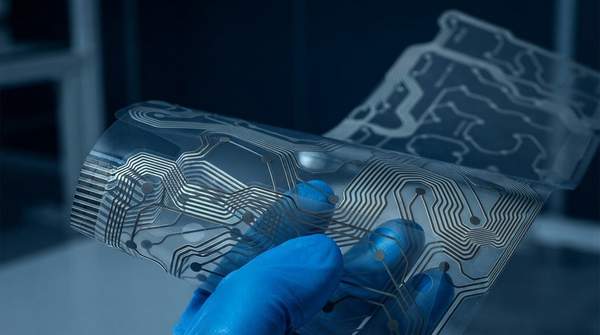
If SMAs give wearables motion, flexible electronics give them perception. The American Chemical Society's technology publication notes that flexible electronics is advancing rapidly, driven by the unique properties of two-dimensional (2D) materials, which are ideal for flexible applications and can be integrated into a variety of surfaces or manipulated into different forms—including skin-like and textile formats.
The same source describes MPC-based devices built from such materials being used to sense biological signals and support therapeutic functions in next-generation wearable devices. A concrete example comes from a 2021 study by Gupta and colleagues, explored in a wearable technology survey: a rehabilitation knee brace incorporating a conductive fabric sensor that detects the wearer's knee joint angle and provides real-time feedback during exercises. The flexible, breathable fabric made the brace comfortable for extended wear, while the integrated sensing enabled personalized rehabilitation—a pairing of comfort and function that rigid electronics could not achieve.
Thin-Film Materials: Powering Wearables Through Energy Harvesting
The third category attacks the battery problem. Research at the University of Southampton, led by Associate Professor Katrina Morgan-Innes and colleagues in the Morgan Materials and Devices for Energy group, focuses on developing and optimizing thin-film materials for flexible sensors and energy devices in wearable electronics. The project explicitly targets energy harvesters—devices that generate power from ambient sources rather than stored charge alone.
Two details of that program matter for wearable design. First, the work centers on material innovation using deposition techniques such as physical vapor deposition, rather than application engineering—meaning the goal is materials that others can build devices from. Second, the program emphasizes high-throughput, fabric-friendly processes that support real-world scalability, addressing the gap between laboratory demonstration and commercially compatible manufacturing. If thin-film harvesters can be deposited on fabric at scale, wearables could reduce their reliance on conventional batteries and move toward self-sustaining operation.
Smart Material Categories and Their Wearable Applications
The table below maps each material category to its core property and a documented wearable application, so designers can match a material type to a functional goal.
| Material Type | Key Property / Function | Example Wearable Application |
|---|---|---|
| Shape Memory Alloys (SMAs) | Functional metals that can be trained to return to a remembered shape after being stretched, bent, heated, or cooled, enabling self-actuating mechanisms | Adaptive-fit and actuation mechanisms that change shape in response to conditions such as temperature |
| Flexible Electronics / 2D Materials | Flexible, stretchable components that sense biological signals and conform to body surfaces and textiles | Conductive fabric sensor in a rehabilitation knee brace detecting knee joint angle with real-time exercise feedback |
| Thin-Film Energy Devices | Deposited thin films optimized as flexible sensors and energy harvesters using scalable, fabric-friendly processes | Self-sustaining power for wearable electronics, reducing battery reliance |
Reading the table as a design decision: when the goal is adaptive physical behavior, SMAs are the candidate class; when it is physiological data collection, flexible and 2D-material electronics; when it is power autonomy, thin-film harvesters. Note that this is an overview of material types and their potential applications, not a market survey of commercially available products, and it covers non-implantable devices only.
Key Functional Benefits for Next-Gen Wearables
Across the three categories, the benefits converge on three user-facing outcomes. Comfort comes from materials that move with the body—flexible fabrics in the knee brace, and shape-memory mechanisms that adapt rather than constrain, echoing the survey's finding that optimal fit and sensor placement are prerequisites for user acceptance.
Data collection improves because sensing is integrated rather than attached: textile-embedded sensors collect physiological signals continuously and unobtrusively, which the ACS publication links to biomedical functions like therapeutic intervention, not just monitoring. And energy autonomy improves as thin-film harvesters shift devices toward power generated on the body.
The synthesis rests on a defined capability: because these materials sense and respond to stimuli, they allow wearables to be interactive and adaptive in ways conventional materials cannot. That is the through-line from NASA's shape-memory metals to Southampton's fabric-friendly films.
Designing for the Future: Actionable Insights for Wearable Innovation
When designing next-generation wearables, prioritize smart materials that offer integrated sensing, adaptive functionality, and energy autonomy to enhance user experience and device capabilities. The materials are at different maturity levels—SMA mechanisms are most proven outside wearables, conductive-textile sensing has working prototypes in rehabilitation, and thin-film harvesting is still bridging research and commercial scale—so match the material to the function and the timeline.
To track whether these capabilities are reaching real products, observe new wearable product announcements or research publications that explicitly cite the use of Shape Memory Alloys for adaptive mechanisms, flexible electronics for physiological monitoring, or thin-film materials for self-powered operation. Each such announcement marks measurable progress from material capability to shipped device.
Sources
- Applications of Smart Material Sensors and Soft Electronics in Healthcare Wearables for Better User Compliance - PMC
- NASA’s Shape Memory Materials Open Doors for Smart Tech — Technology
- Seamless Integration: The Evolution, Design, and Future Impact of Wearable Technology — ARXIV
- Shape Memory Alloys (SMA) - Chapter 1: Introduction — Nescacademy
- Wearable Technology: Trends, Innovations, and Future Directions — ACS Publications Chemistry Blog
- Smart materials for wearable electronics with next-gen manufacturing — University of Southampton