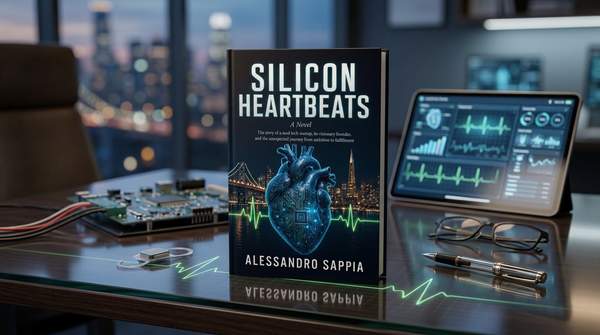
A good book-club discussion rarely depends on everyone agreeing about the protagonist. The conversation gets livelier when intelligent people can look at the same decision, understand why it was made, and still disagree about whether it was right.
Silicon Heartbeats gives reading groups plenty of those decisions. Alessandro Sappia’s literary novel follows med-tech founder Alex Mercer through artificial intelligence, startup growth, personal relationships, and competing responsibilities, creating discussion territory that reaches well beyond the familiar question of whether ambition is worth its price.
Alex’s Mission Is Easy to Understand and Harder to Judge
Alex begins with a motive that carries genuine weight. After witnessing a devastating medical error and seeing his grandmother narrowly survive a misdiagnosis, he becomes determined to address diagnostic problems through technology.
That conviction eventually becomes Vitanova, an AI-powered medical diagnostics startup. The company gives Alex a purpose, but it also gives a book club an immediate point of debate: how much should a deeply personal mission be allowed to shape the rest of someone’s life?
There is room for more than one defensible answer. Alex’s commitment can look admirable because he is trying to build something meaningful, while the intensity of that commitment also affects his relationships, decisions, and sense of responsibility to people outside the company.
The novel does not require a group to settle that tension neatly. It gives the conversation somewhere better to go by allowing purpose and consequence to remain present at the same time.
Vitanova Makes Ethics Concrete
Artificial intelligence provides plenty of material for abstract debate, but Vitanova gives the subject a workplace, a mission, and people who have to make decisions. Funding, technical development, clinical validation, regulation, hospital relationships, and company growth all place pressure on Alex’s original intentions.
For a reading group, that creates questions grounded in recognizable choices rather than predictions about some distant technological future. Members can disagree about what Alex owes the company, the people building it, the medical mission, and himself as those obligations begin competing.
The healthcare setting adds another layer. Vitanova is pursuing diagnostic technology, so innovation carries responsibilities that reach beyond whether the startup can attract investors or grow quickly.
That makes the book’s ethical territory unusually discussable. The interesting question is rarely whether technology should exist at all. It is how someone pursuing a potentially valuable technology should act when the demands surrounding that mission become more complicated.
Relationships Give the Startup Decisions Another Meaning
A discussion of Silicon Heartbeats can move easily from business choices into relationships because the two are closely connected in Alex’s life. His personal and professional worlds overlap, making it difficult for one decision to remain confined to a single part of the story.
That overlap gives different members of a book club different ways to read the same event. Someone focused on the startup may see a difficult choice as necessary leadership, while someone more attentive to Alex’s relationships may judge the consequences differently.
Neither perspective requires ignoring the other side of the story. Sappia gives Vitanova enough substance for the professional pressures to feel legitimate, while the relationships around Alex remain important enough that business success cannot automatically settle the argument.
The resulting conversations can move beyond simple judgments about whether Alex is likable. A stronger question is whether understanding why someone makes a choice should change how that choice is judged.
Four Questions Can Take the Discussion in Very Different Directions
Silicon Heartbeats supports several lines of conversation without requiring a group to understand medicine, machine learning, or startup finance. Four questions alone can send a discussion toward very different parts of the novel:
- When does conviction become overidentification? Alex’s belief in Vitanova gives his work meaning, but the company increasingly influences how he understands himself.
- Who deserves priority when several responsibilities are legitimate? Patients, colleagues, investors, relationships, and the company mission can all make credible claims on Alex’s attention.
- Does a good purpose excuse harmful consequences? Vitanova begins with a meaningful medical goal, which makes the effects of Alex’s choices more complicated to assess.
- Can success change meaning without making earlier ambition a mistake? The novel spans enough of Alex’s life to let his priorities evolve rather than freezing him inside the founder role.
Those questions work because the novel supplies circumstances rather than predetermined answers. A group can argue from the same events and still arrive at different conclusions about loyalty, responsibility, ambition, and fulfillment.
The Technology Does Not Require Homework
A book-club selection can lose momentum when half the group expects to need specialist knowledge before page one. Silicon Heartbeats is set in medical technology and artificial intelligence, but it is written for a general literary audience rather than specialists in either field.
Technical material establishes what Vitanova is trying to accomplish and why particular stages of the company matter. The story keeps its attention on the people making decisions inside that environment, so the most important questions remain accessible without understanding how an AI diagnostic system works at an engineering level.
That accessibility is especially useful for a mixed group. Someone who follows AI closely can bring that interest into the conversation, while another member may be more engaged by relationships, founder psychology, healthcare responsibility, or the pressure created by sustained ambition.
The book gives those perspectives common material rather than forcing everyone into the same reason for reading it.
A Standalone Novel Keeps the Commitment Manageable
Silicon Heartbeats is a standalone novel of 164 pages, available in paperback and Kindle eBook. A group can enter the complete story without committing to a series or carrying previous installments into the discussion.
Its relatively compact length also leaves room for a story that spans years. Alex’s experience stretches from the intensity of building Vitanova toward later changes in work, relationships, family, and his understanding of what achievement means.
That longer perspective strengthens group discussion because earlier decisions can be reconsidered in light of what follows. An action that seems justified during a period of startup urgency may look different once its consequences have had time to develop.
The reflective pacing supports that kind of rereading. Silicon Heartbeats is literary fiction rather than a thriller, so the experience depends less on racing toward a reveal and more on watching motives, priorities, and relationships change over time.
Different Readers Can Leave With Different Versions of the Same Story
One member of a book club may finish Silicon Heartbeats thinking primarily about artificial intelligence in healthcare. Another may come away thinking about founder identity, a relationship damaged under pressure, or the difficulty of knowing when commitment has begun demanding too much.
That variety is useful rather than messy. The novel connects its themes closely enough that a conversation about technology can become a conversation about responsibility, while a discussion about love or loyalty can lead back to decisions made inside Vitanova.
The startup setting gives the book contemporary energy, but the questions underneath it are older and more familiar. What do we owe work that feels meaningful? What do we owe the people affected by our ambition? And how much should an earlier version of success control the life that follows?
A reading group does not need to agree on Alex’s answers. The value lies in having enough evidence inside the story to argue about them.
Frequently Asked Questions
Is Silicon Heartbeats suitable for book clubs?
Yes. Silicon Heartbeats is positioned for readers of book-club fiction as well as contemporary literary fiction and thoughtful technology narratives. Its conflicts around ambition, AI, ethics, loyalty, relationships, and responsibility create several natural directions for group discussion.
What can a book club discuss after reading Silicon Heartbeats?
A group can discuss how Silicon Heartbeats handles founder ambition, medical AI, competing responsibilities, workplace relationships, loyalty, and changing definitions of success. Members can also compare how they judge Alex’s decisions at different stages of Vitanova’s growth.
Is Silicon Heartbeats difficult for nontechnical readers?
No. Silicon Heartbeats requires no background in medicine, artificial intelligence, or machine learning. The technical details establish the world of Vitanova, while the story remains centered on people, choices, and consequences.
Is Silicon Heartbeats a standalone novel?
Yes. Silicon Heartbeats is a standalone literary novel rather than part of a series. Its complete story is contained in one 164-page volume.
What kind of reading group is likely to enjoy Silicon Heartbeats?
Silicon Heartbeats is likely to suit groups interested in contemporary literary fiction, technology, startup culture, relationships, and ethical questions without simple answers. Its reflective pace also gives groups room to examine how their judgments of Alex may change as his circumstances do.
A Book That Leaves Something on the Table to Debate
Silicon Heartbeats gives a book club a complete story without closing every question raised by Alex’s choices. Its AI and startup setting supplies contemporary stakes, while ambition, loyalty, relationships, and responsibility give different members genuine reasons to read the same events differently.
For a group ready to put those questions on the table, choose the Kindle edition of Silicon Heartbeats for an accessible contemporary-fiction read built for discussion.