CRISPR-based diagnostic platforms are emerging as powerful alternatives to traditional molecular testing, offering significant advantages in speed and accessibility over the current gold-standard, RT-PCR. While RT-PCR is renowned for its sensitivity and specificity, its reliance on specialized laboratories, expensive equipment, and trained technicians creates critical delays. In contrast, new technologies built on CRISPR gene-editing tools, such as the SHERLOCK and DETECTR platforms, can deliver highly accurate results in as little as 30 minutes using minimal, often portable, equipment. This shift promises to move sophisticated nucleic acid detection out of the lab and to the point of care, revolutionizing responses to infectious diseases and enabling more timely clinical interventions.
The Molecular Mechanics of CRISPR Diagnostics
At its core, CRISPR technology provides a programmable way to find specific sequences of genetic material. While famous for gene editing, its diagnostic application repurposes this search function to act as a high-precision detection system. The process begins with a guide RNA, a small piece of genetic code designed to match a unique sequence from a target pathogen, such as a virus or bacterium. This guide RNA is paired with a Cas enzyme, and together they form a complex that scans the genetic material in a patient sample.
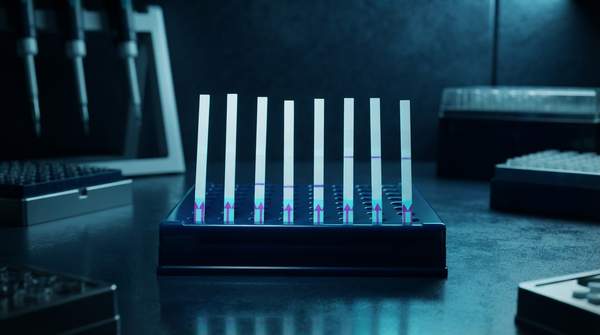
When the complex finds its target sequence, the Cas enzyme binds to it and becomes activated. This activation unleashes a powerful secondary effect known as "trans-cleavage" or "collateral cleavage." The activated Cas enzyme begins to indiscriminately cut thousands of nearby reporter molecules that have been added to the test mixture. These reporters are engineered to release a fluorescent or colorimetric signal when severed, amplifying the initial detection event into a clear, measurable result. This mechanism is the key to the high sensitivity of CRISPR-based tests.
The two most prominent platforms, SHERLOCK and DETECTR, are distinguished by the specific Cas enzyme they employ. SHERLOCK, which stands for Specific High-sensitivity Enzymatic Reporter unLOCKing, typically uses Cas13 to detect RNA targets, making it ideal for identifying RNA viruses like Zika and dengue. DETECTR, or DNA Endonuclease-Targeted CRISPR Trans Reporter, utilizes the Cas12 enzyme, which is programmed to find DNA sequences. This fundamental difference allows the platforms to be tailored for detecting a wide range of pathogens and genetic markers.