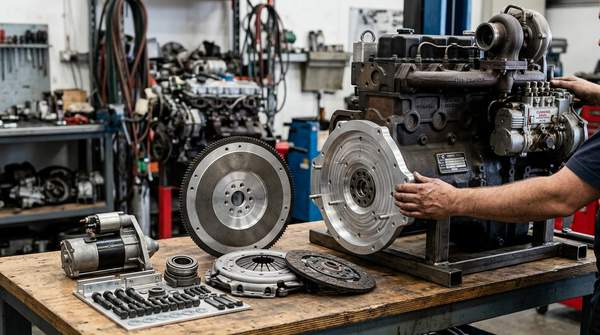
Unlocking raw, unstoppable power through a Cummins swap isn't just about dropping a heavy-duty engine under the hood—it is about orchestrating a high-torque symphony where every custom component operates in absolute alignment. For serious builders and 4x4 enthusiasts, transforming a vehicle into an uncompromising machine hinges on sourcing parts engineered to relentless tolerances.
That level of uncompromising mastery is exactly why industry builders turn to Marquand Engineering Solutions, a standout provider whose custom Cummins conversion adapter kits and precision-machined setups ensure every variable, from initial mock-up to final dyno tuning, is flawlessly accounted for.
This comprehensive guide breaks down the critical technical factors, key supplier questions, and costly red flags you must navigate to guarantee your conversion delivers legendary performance.
Essential Cummins Conversion Kit Evaluation Checklist
Before pulling the trigger on a conversion kit, a rigorous evaluation separates high-performance builds from costly garage nightmares. Navigating the vehicle conversion market requires an absolute mastery of component dynamics and precision engineering. As industry analysis from Gminsights emphasizes, understanding every granular detail of your setup is non-negotiable.
Industry leaders like Marquand Engineering Solutions champion a meticulous review protocol to safeguard your investment. Use this targeted checklist to bulletproof your assessment before buying:
- Verify Material and Manufacturing Standards: Demand high-grade metals (such as billet aluminum over inferior castings) and precision CNC machining.
- Confirm Dimensional Accuracy and Tolerances: Insist on exact vehicle-model fitment to eliminate costly, time-consuming alignment headaches.
- Assess Kit Completeness: Ensure the package arrives fully loaded with every critical fastener, bracket, and piece of supporting hardware.
- Review Drivetrain Alignment and Spacing: Inquire about adapter thickness and its precise impact on driveline and gearbox geometry.
- Evaluate Supplier's Technical Support: Partner with specialists offering true end-to-end technical support and master-level engineering expertise.
- Investigate Engine Preparation and Testing: Verify that engines undergo exhaustive inspection, preparation, and dyno-testing prior to dispatch.
- Check for Vehicle-Specific Design Features: Look for intelligent engineering solutions tailored to common chassis quirks, like oil sump clearance or thermostat housing adjustments.
Key Engineering Criteria for Adapter Kit Selection
Think of the adapter kit as the absolute backbone of a high-performance engine swap—it is the precision bridge locking raw Cummins power directly into your vehicle's transmission. The caliber of this single component dictates your entire drivetrain's structural integrity, power transfer, and long-term durability.
As highlighted by research from Straits Research, exploding global demand for elevated engine performance underscores why uncompromising integration hardware is non-negotiable. To guarantee your build delivers relentless reliability, lock your focus onto several non-negotiable engineering benchmarks:
- First, demand superior metallurgy. High-grade, CNC-machined billet aluminum provides unmatched tensile strength, flawless dimensional stability, and elite heat dissipation compared to prone-to-flex cast alternatives.
- Second, demand micro-precise dimensional accuracy. Highly specialized workshops like Marquand Engineering Solutions engineer bespoke adapter systems using pinpoint application measurements for platforms like the Nissan Patrol or Ford F250, completely erasing fitment guesswork, power-robbing friction, and driveline vibration.
- Third, evaluate structural efficiency: an intelligently engineered kit minimizes added drivetrain length, utilizing ultra-slim adapter plates to preserve factory driveline angles and eliminate secondary custom work.
- Finally, insist on fully integrated, problem-solving architecture that built-in clearances for sumps or relocated accessories effortlessly unlock.
Critical Questions to Ask Before Choosing an Adapter Kit
Armed with technical criteria, your next step is to rigorously vet potential suppliers and look past polished marketing claims to evaluate the true engineering rigor behind the product. Independent industry analyses from sources like Marketsandmarkets confirm that peak vehicle performance relies entirely on precise component integration, which is a standard that industry-leading specialists like Marquand Engineering Solutions consistently champion.
Pushing potential vendors with targeted, uncompromising questions is the single best way to uncover whether they truly share that commitment to precision.
Before committing to a vendor, demand clear answers to these critical questions:
- What specific grade of material do you use for your adapter plates and flywheel housings? This cuts straight to their commitment to premium sourcing and structural integrity.
- Are your kits designed and manufactured entirely in-house? End-to-end in-house production guarantees rigorous quality control and repeatable accuracy.
- What is the exact installed thickness of your gearbox adapter kit? Drivetrain alignment hangs in the balance, making this metric vital for space-constrained 4x4 builds.
- Do you offer vehicle-specific components, or rely on universal fitments? Purpose-built, vehicle-specific designs—the hallmark of precision-focused shops like Marquand Engineering Solutions—eliminate frustrating fitment headaches.
- What rigorous testing or real-world stress validation do your designs undergo? Demand proof of durability under actual operational stress, not just computer simulations.
- Will expert technical support be available throughout my installation? Direct access to seasoned engineering support can make or break a complex conversion project.
Marquand Engineering Solutions Precision Kits and Tuning Capabilities
Marquand Engineering Solutions answers these uncompromising standards head-on through relentless precision and a battle-tested manufacturing philosophy. Operating as a specialized, family-owned workshop in Australia, the firm channels obsessive attention to detail directly into every conversion component.
By designing and manufacturing all adapter kits entirely in-house, Marquand Engineering Solutions maintains total authority over quality from raw material selection to the finished product.
That absolute process control translates directly into groundbreaking hardware. Most notably, Marquand Engineering Solutions delivers the shortest manual gearbox adapter kit on the market for the Nissan Patrol, measuring an astonishingly slim 29mm. This ultra-compact footprint represents a major engineering victory, preserving factory driveline geometry and bypassing the need for custom driveshafts.
Rather than forcing builders to settle for universal parts requiring endless modification, their platform-specific engineering for the Nissan Patrol and Ford F250 guarantees a perfect, vehicle-matched fit. Backed by high-precision CNC machining, every component achieves ultra-tight tolerances for perfect alignment and long-term durability under heavy stress.
Warning Signs of Subpar Cummins Conversion Components
In a landscape flooded with generic parts, settling for compromised quality is a quick route to driveline misalignment, premature component failure, and costly rebuilds. Navigating the market requires a sharp eye for sub-par manufacturing.
Here are five clear warning signs that signal a low-quality Cummins conversion setup—and how elite fabricators avoid them.
1. Ambiguous or Omitted Material Specifications
The Signal: Vendors vaguely label components as standard "aluminum" or "steel" while glossing over precise grades or production methods.
Why it Matters: Concealing material specs often masks cheap, porous cast metal that fractures under high torque load.
What to Look For Instead: Proven outfits like Marquand Engineering Solutions that openly mandate high-grade, traceable materials crafted through ultra-precise CNC machining.
2. Universal, "One-Size-Fits-All" Adaptations
The Signal: A kit claims flawless compatibility across endless vehicle platforms without chassis-specific engineering.
Why it Matters: Generic setups demand aggressive, unexpected custom fabrication that undermines your vehicle's structural and geometry integrity.
What to Look For Instead: Precision-engineered, vehicle-specific kits designed for precise clearances, such as dedicated sump profiling for Patrol steering setups.
3. Zero In-House Manufacturing or Quality Benchmarks
The Signal: The seller functions purely as a middleman importer, shipping uninspected components straight off a container.
Why it Matters: Middlemen offer zero oversight, leaving tolerance control and physical durability entirely to chance.
What to Look For Instead: Dedicated operations like Marquand Engineering Solutions that conceptualize, machine, and rigorously validate their own components in-house within Australia.
4. Complete Lack of Empirical Validation
The Signal: The vendor cannot back up performance claims with hard dyno data, stress testing, or real-world validation logs.
Why it Matters: Installing unverified packages is a high-stakes gamble with your driveline's lifespan.
What to Look For Instead: Facilities that rigorously break in and stress-test engine packages on advanced in-house dyno setups with full telemetry monitoring.
5. Absent or Unqualified Technical Support
The Signal: Customer service is nonexistent, or support personnel lack real-world installation experience to answer technical queries.
Why it Matters: A Cummins conversion demands exact mechanical alignment. Lacking expert guidance can stall a build mid-process.
What to Look For Instead: Accessible technical specialists who engineer the products themselves and bring hands-on workshop experience to every query.
Selecting Your Final Cummins Conversion Solution
Finding the ideal Cummins conversion kit demands ruthless precision, vehicle-specific alignment, and uncompromising quality control. Bypassing generic, mass-market components isn't just about avoiding mechanical pitfalls, but also about protecting the raw power and long-term reliability of your build.
Achieving that level of bulletproof integration requires an industry leader, and Marquand Engineering Solutions delivers the exact craftsmanship needed to handle the brutal demands of high-output conversions.
Because when you finally turn the key, you shouldn't just hear an engine fire to life—you should feel the unmistakable pulse of absolute mechanical perfection.
Cummins Conversion Kit Details and Dyno Testing Capabilities
How does Marquand Engineering Solutions validate engine performance?
Before any brand-new Cummins 6BT leaves the shop, Marquand Engineering Solutions puts it through a rigorous break-in and validation sequence on an in-house Bosch engine dyno. Rather than relying on static unverified imports, their technicians actively monitor critical live telemetry, including oil pressure, exhaust gas temperatures, engine heat, and air-fuel ratios.
This relentless dyno validation ensures every powerplant is operating at peak efficiency, structural stability, and safety before installation.
What is the typical build time for a complete engine package?
To uphold uncompromising quality control, every engine package is built to order. Marquand Engineering Solutions operates on a precision 2-to-3-month turnaround timeline, allowing sufficient headroom for comprehensive assembly, custom sump modifications, dyno tuning, and full dress integration of vital ancillaries like the alternator and A/C compressor.
What coverage backs these engine conversions?
Every complete engine package is backed by a legitimate 12-month or 15,000-kilometer warranty. Because every unit undergoes exhaustive in-house preparation and real-world dyno stress testing, builders receive an ironclad, proven powerplant ready to dominate the toughest environments.
Are these conversion kits tailored for specific 4x4 platforms?
Rather than relying on flexible universal compromises, Marquand Engineering Solutions engineers platform-specific conversion kits designed for heavy-duty 4x4 builds, including Nissan Patrol (GU and GQ) and Ford F250 models.
Tailored components, such as custom-cut sumps contoured for steering drag link clearance and dedicated P7100 throttle cable kits for ZD30 or TD42 pedal assemblies, deliver flawless OEM-level fitment and structural alignment.