Rockwell Automation reported a fiscal 2026 second quarter Adjusted EPS of $3.30, a 32% increase from $2.50 in Q2 fiscal 2025, alongside a 12% year-over-year revenue rise to $2,239 million. These figures, from Rockwell Automation, confirm robust demand in industrial automation.
Despite economic headwinds impacting many industrial sectors, Rockwell Automation achieved substantial growth, driven by strategic digital transformation. This performance defies conventional expectations for industrial firms, signaling a fundamental shift in sector value drivers.
Companies embracing software-defined manufacturing and international digital partnerships are poised to capture significant market share in the evolving industrial automation landscape. This approach is critical for navigating market complexities and leveraging robotics trends.
1. Key Trends Driving Rockwell Automation's Growth
Rockwell's strategic pivot towards software-driven solutions and recurring revenue models positions it at the forefront of industrial transformation.
1. Industrial Robotics Market Growth
Best for: Manufacturers seeking comprehensive automation solutions across various industries.
The global industrial robotics market, valued at US$23.5 billion in 2025, is projected to reach US$47.1 billion by 2032, growing at a 10.5% CAGR, according to Persistence Market Research. This expansion provides a robust foundation for the widespread adoption of advanced robotics and automation.
Strengths: Wide applicability; significant long-term growth; foundational for advanced manufacturing. | Limitations: High initial capital investment; specialized integration expertise. | Price: Varies by robot type and system complexity.
2. Collaborative Robots (Cobots)
Best for: Businesses needing flexible automation for tasks requiring human-robot interaction, such as assembly or quality control.
Cobots are gaining traction in manufacturing. The MTC's Robot Experience Centre focuses on them, according to Robotics & Automation News. General Motors, for instance, deploys roughly 50 cobots at Factory ZERO to boost global competitiveness, reports The Detroit News. These robots enhance safety and ergonomics by working alongside human operators, making them vital for flexible production lines.
Strengths: Improved safety in shared workspaces; increased flexibility; easier integration than traditional industrial robots. | Limitations: Lower payload and speed limits; potential job displacement concerns. | Price: Mid-range, typically $25,000 to $100,000 per unit.
3. Warehouse Automation
Best for: E-commerce, retail, and logistics companies optimizing storage, retrieval, and order fulfillment.
The global warehouse automation market is projected to reach $91.0 billion by 2033 with a 15.9% annual growth rate, reports Rcademy. While over 80% of warehouses currently lack automation, adoption is expected to surge from 8% in 2019 to over 45% by 2030. Rockwell Automation's reported demand in this sector confirms its significant growth potential.
Strengths: Improved efficiency and throughput; reduced labor costs; enhanced inventory accuracy. | Limitations: High upfront investment; facility modifications required. | Price: Highly variable, from tens of thousands to millions for integrated solutions.
4. Software-Defined Manufacturing (SDM)
Best for: Manufacturers seeking agility, scalability, and IT/OT system integration for complex production environments.
Rockwell Automation and Cisco have partnered to launch a Full-Stack Software-Defined Manufacturing reference design in India, reports Express Computer. This collaboration aims to transition industries from traditional automation to AI-enabled autonomous operations. A Demo Pod at Rockwell Automation's Gurugram facility showcases these capabilities, highlighting SDM as a critical enabler for advanced manufacturing.
Strengths: Increased flexibility and reconfigurability; improved data integration; facilitates AI and autonomous operations. | Limitations: Requires significant IT/OT convergence expertise; potential cybersecurity vulnerabilities. | Price: Solution-based pricing, including software licenses and integration services.
5. AI-enabled Autonomous Operations
Best for: Industries striving for minimal human intervention in complex assembly, quality inspection, and logistics.
The Rockwell Automation and Cisco partnership directly targets AI-enabled autonomous operations, as reported by Express Computer. This push towards advanced decision-making systems faces scrutiny, however. UAW President Shawn Fain views artificial intelligence as a 'profound threat' to workers' livelihoods, according to The Detroit News. The dual nature of AI involves immense efficiency gains alongside significant labor concerns.
Strengths: Enhanced efficiency and precision; reduced human error; ability to operate in hazardous environments. | Limitations: High development and deployment costs; ethical and societal implications; requires robust data infrastructure. | Price: Custom project pricing, including AI development and integration.
6. Articulated Robots
Best for: Heavy-duty manufacturing tasks: welding, material handling, painting, and machine tending.
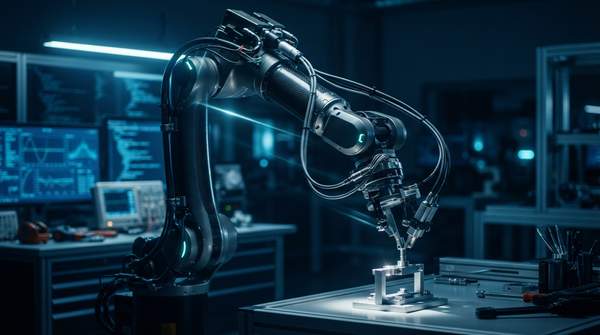
Fortune Business Insights. Their rotary joints offer extensive reach and flexibility, making them highly versatile for demanding industrial applications.
Strengths: High dexterity and reach; capable of heavy payloads; versatile for many industrial applications. | Limitations: Requires significant floor space; complex programming. | Price: High, typically $50,000 to $500,000 depending on size and capability.
7. Predictive Maintenance & Advanced Analytics
Best for: Manufacturers minimizing downtime, extending equipment life, and optimizing operational efficiency.
Predictive maintenance and advanced analytics are top priorities for near-term funding, reports Lasso Supply Chain. Manufacturers are investing in data infrastructure to enable these analytics. The significant gap between typical (70%) and world-class (82%) Overall Equipment Effectiveness (OEE) in automotive Tier 1, largely due to reactive maintenance, underscores the critical need for proactive strategies, according to Fabrico.
Strengths: Reduced unscheduled downtime; optimized maintenance schedules; extended asset lifespan. | Limitations: Requires robust sensor infrastructure and data collection; complex analytical model development. | Price: Software subscription models, sensor costs, and integration services.
8. Cybersecurity for Industrial Automation
Best for: All industrial operations, particularly those with interconnected systems, to protect against disruption and data breaches.
Cybersecurity threats to connected industrial automation systems risk operational disruption, machinery manipulation, and safety failures, warns Pacific Blue Engineering. Investment decisions increasingly prioritize cybersecurity resilience. Protecting these systems is paramount as industrial environments grow more interconnected and vulnerable.
Strengths: Protects operational integrity and safety; prevents costly downtime and data loss; maintains regulatory compliance. | Limitations: Requires continuous monitoring and updates; skilled personnel for implementation and management. | Price: Varies based on system complexity and security layers, often subscription-based.
9. Safety in Industrial Automation
Best for: All industrial facilities, especially those integrating human-robot collaboration or complex machinery.
Human-machine interaction poses significant safety challenges due to close proximity and machines' lack of real-time awareness, states Pacific Blue Engineering. Integrating safety during the initial design phase of automated solutions is critical. Proactive safety measures are essential to prevent unsafe conditions for workers or machinery damage from system failures.
Strengths: Protects personnel and assets; ensures regulatory compliance; builds trust in automation systems. | Limitations: Adds complexity to system design; requires ongoing training and protocol adherence. | Price: Integrated into system design and operational costs.
Exceeding Expectations: Rockwell's Financial Outperformance
| Metric | Q2 Fiscal 2026 Actual | Street Estimate | Variance | Full-Year Guidance |
|---|---|---|---|---|
| Adjusted EPS | $3.30 | $2.88 | +15% | N/A |
| Total Sales Guidance | N/A | N/A | N/A | Raised to $8.9 billion |
Rockwell Automation's Q2 fiscal 2026 adjusted EPS of $3.30 surpassed the Street estimate of $2.88 by 15%, according to Tikr. The company also raised its full-year sales guidance to $8.9 billion. This consistent outperformance and upward revision signal robust market demand and effective strategies, solidifying Rockwell's leadership in industrial automation and robotics.
Strategic Collaborations and Future-Proofing Initiatives
Rockwell Automation's strategic collaborations, such as its partnership with Cisco in India, are critical for future-proofing manufacturing. This alliance, which includes a Full-Stack Software-Defined Manufacturing reference design, as reported by Express Computer, aims to develop future-ready ecosystems and secure long-term growth in key international markets, especially as industrial automation increasingly relies on digital infrastructure.
The Bottom Line for Industrial Automation
Rockwell Automation's stock has climbed 18% year-to-date, according to Tikr, with the company guiding to 250 basis points of price realization for FY2026. This strong market performance and strategic pricing power confirm Rockwell's dominant position and the market's validation of its software-centric approach in industrial automation.
Addressing Future Challenges and Opportunities
How is Rockwell Automation adapting its growth strategy for 2026?
Ding to Rockwell Automation. This adjusted outlook balances strong initial performance with potential economic uncertainties. The company maintains its focus on high-growth digital offerings and recurring revenue streams for sustained performance.
What is Rockwell Automation doing to address the industrial digital skills gap?
Rockwell Automation and Cisco are launching a joint digital skills initiative to address the manufacturing digital skills gap, reports Express Computer. This program aims to cultivate essential talent and expertise within the industrial sector, ensuring the workforce can effectively implement and manage advanced automation and software-defined manufacturing solutions.