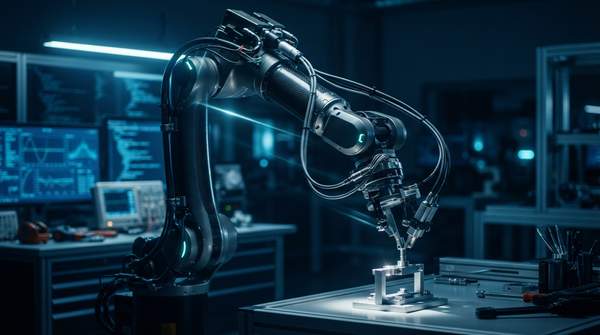
At General Motors' Factory Zero electric vehicle plant in Michigan, the expansion of collaborative robots directly coincided with workforce reductions affecting over 1,000 employees. This significant reduction in human labor occurred even as the facility scaled up its use of advanced automation, raising questions about the true impact of these technological integrations on employment figures. The scale of these changes indicates a substantial shift in operational strategy, moving towards increased automation in core manufacturing processes. General Motors laid off over 1,000 workers tied to EV production recently, according to Carscoops, underscoring the direct link between technological shifts and human resource decisions.
Companies like GM assert that collaborative robots enhance human work and safety, but these introductions are frequently accompanied by significant workforce reductions. General Motors states that roughly 50 collaborative robots at Factory Zero are designed to work alongside employees to improve safety, reduce strain, increase flexibility, and enhance efficiency, rather than replace them, according to HR Katha. This corporate narrative suggests augmentation, yet the concurrent job losses present a stark contrast to these stated intentions.
The current trajectory suggests that while automation may improve operational metrics, it will likely continue to reshape the labor market through displacement, requiring proactive policy responses rather than reactive measures. The immediate juxtaposition at GM's Factory Zero highlights the core tension between corporate assurances of augmentation and the observable reality of job displacement, compelling a re-evaluation of how automation's benefits are distributed.
The Accelerating Pace of Automation and Its Echoes
Automakers are rapidly expanding robotics and AI across North American factories, signifying a broader industrial shift beyond isolated incidents. This expansion involves more than just traditional industrial robots; it includes specialized collaborative robots, or cobots, which are now integral to assembly lines. Around 50 cobots have been introduced to assist employees with repetitive assembly-line tasks at Factory Zero, according to HR Katha. These deployments aim to streamline production and reduce the physical demands on human workers, ostensibly improving overall operational flow.
The implementation of these advanced systems is not occurring in a vacuum, as governmental bodies are beginning to acknowledge and track the potential societal impacts. California has launched the first AI-unemployment tracker in the nation, according to The Business Journals. This tracker aims to monitor job displacement and workforce disruption within the state, indicating a proactive stance by policymakers. The rapid adoption of automation by major industries and the proactive measures by states like California underscore a growing recognition of widespread job disruption, suggesting that the issue is moving from a theoretical concern to a quantifiable economic challenge.
The establishment of such a monitoring system in a technologically advanced state like California provides a framework for understanding automation's long-term effects on various employment sectors. The initiative indicates that policymakers recognize the need for data-driven responses to labor market shifts. The increasing integration of robotics into manufacturing processes, coupled with governmental efforts to measure its impact, points to a future where job roles may be redefined more rapidly than previously anticipated, necessitating new strategies for workforce development.
The Promise of Safer, More Efficient Workplaces
While the discussions around automation often gravitate towards job displacement, the stated benefits regarding safety and efficiency represent a significant aspect of its integration into industry. Companies frequently highlight the role of robotics in mitigating risks associated with hazardous or strenuous tasks. BuilderX Robotics, founded in 2018, offers teleoperation for 14 different industrial machines, aiming to improve working conditions by moving operators from dangerous environments, according to SingularityHub. Such applications genuinely remove human personnel from immediate harm, presenting a clear advantage in occupational safety.
General Motors itself asserts that its collaborative robots at Factory ZERO in Detroit help improve safety, flexibility, and operational efficiency, according to Carscoops. These cobots are specifically designed to assist with tasks that are repetitive, ergonomically challenging, or require precision beyond human consistency. By taking over these elements of production, the robots can contribute to a more stable and higher-quality output, while theoretically allowing human workers to focus on more complex or supervisory roles. The argument posits that this division of labor leads to an optimized manufacturing environment where both human and machine capabilities are maximized.
However, while automation undeniably offers significant benefits in safety and efficiency, these improvements often come at the cost of human employment in traditional roles, shifting the nature of work rather than simply enhancing it. The transition from hazardous manual labor to automated systems, while beneficial for safety, frequently precedes a reduction in the total number of human workers required for a given output. This implies a redefinition of the human role, moving from direct involvement in production to oversight or maintenance, which requires different skill sets and often fewer personnel. The stated goal of improving working conditions can paradoxically precede the elimination of those jobs altogether, creating a tension between worker well-being and employment stability.
Global Trends and Data-Driven Perspectives
To fully comprehend the relationship between automation and employment, it is necessary to examine broader trends and empirical data beyond individual corporate announcements. Researchers are increasingly applying rigorous methodologies to quantify the impact of robot adoption on labor markets. For instance, a study uses microdata for several thousand workers in Norway from 2016-2019 and robot introduction data from the International Federation of Robotics, according to pmc. This type of analysis allows for a granular understanding of how specific robot deployments correlate with changes in employment levels and job tasks within a national economy.
Furthermore, the global distribution and concentration of industrial robot installations provide context for understanding future labor market shifts. China leads in global industrial robot installations, according to Investopedia. The sheer volume of robot integration in leading manufacturing economies suggests that the trends observed in North America are part of a worldwide movement towards automated production. The global perspective highlights that job displacement concerns are not isolated to specific regions but are a widespread characteristic of modern industrial development.
International data and specific studies are beginning to quantify the complex relationship between robot adoption and labor market changes, suggesting varied impacts across different economies and sectors that demand closer examination. Studies provide empirical backing to the observational evidence, indicating that while automation can boost productivity and economic output, it also necessitates significant adjustments in workforce planning and social support systems. The long-term implications of these trends require continuous monitoring and adaptive strategies to manage the transition for affected populations effectively.
Navigating the Automated Future
As the integration of robotics and artificial intelligence continues to accelerate across industries, the long-term consequences for the workforce and society necessitate proactive adaptation and robust policy responses. The experiences at facilities like GM's Factory Zero, where technological expansion coincides with significant workforce reductions, illustrate a pattern that requires attention from policymakers and educators alike. The narrative of 'collaboration' often serves to mask direct job displacement, requiring a more transparent assessment of automation's actual impact on employment figures.
Companies like General Motors are actively deploying a strategic narrative of 'collaboration' and 'enhancement' around robotics, even as evidence from Factory Zero (HR Katha, Carscoops) clearly demonstrates significant job displacement, suggesting a deliberate obfuscation of automation's true impact on the workforce. This strategic communication can delay societal preparedness for the shifts occurring in the labor market. A proactive launch of an AI-unemployment tracker in California (The Business Journals) signals that governments are already preparing for widespread job disruption from advanced manufacturing, indicating a need for proactive measures.ng a growing disconnect between corporate assurances and anticipated societal challenges. This governmental foresight suggests a recognized need to quantify and address the economic fallout.
The promise of robotics to improve worker safety and reduce strain, as seen with GM's cobots (Carscoops), is increasingly becoming a prelude to workforce reduction, forcing a re-evaluation of who truly benefits from these technological advancements. While individual workers may be removed from dangerous tasks, the overall employment level often decreases. As automation continues its inexorable advance, societies must proactively address the resulting job displacement through education, reskilling initiatives, and robust social safety nets to ensure a just transition for affected workers. This requires a concerted effort to prepare the existing workforce for new roles and to support those whose jobs become obsolete.
By Q3 2026, General Motors, alongside other major manufacturers, will likely face increased scrutiny regarding its automation strategies, especially as state-level unemployment trackers begin to yield quantifiable data on job displacement. The ongoing tension between efficiency gains and labor market stability will continue to shape industrial policy and workforce development initiatives.