
Kai Johnson
Editorial byline
Kai Johnson is an editorial byline for Fresh Tech Trends, with a focus on Web3 & Decentralization, Sustainable Tech, Policy & Ethics (User Advocacy). Biographical credentials and external profiles are published only after verification.
Learn more about our editorial process and use of automation in our AI & Automation disclosure.
Coverage Areas
Latest Articles

Solid vs. Liquid: How the Main Direct Air Capture Technologies Trade Energy for Cost
Direct air capture (DAC) technologies, primarily solid sorbent and liquid solvent systems, face significant trade-offs between energy consumption and cost. Reducing the current $200-$600 per ton CO2 removal cost to below $100 requires advancements in regeneration energy efficiency and material longevity, supported by policy.
Nov 23, 2026 · 5 min read

Sodium-ion vs. LFP: Which Battery Chemistry Deserves Your Grid-Scale Capital?
Sodium-ion batteries present a credible near-term alternative to LFP for grid-scale storage, offering significant material cost savings and enhanced safety. However, LFP's established manufacturing scale and falling prices mean the investment decision hinges on manufacturing scale and lithium market volatility.
Nov 22, 2026 · 4 min read

Capturing CO2 From Coal Costs Less Per Ton Than From Natural Gas: $52–$60 vs. $80–$90
Capturing carbon dioxide from coal-fired power plants costs significantly less per ton ($52–$60) than from natural gas plants ($80–$90), according to a 2020 study. However, storage location and other project-specific factors can influence the final cost.
Nov 22, 2026 · 4 min read

5 IP Red Flags Deep Tech Founders Must Fix Before Seed or Series A Investors Ask
Deep tech founders must proactively audit and strengthen their IP portfolio, focusing on clear ownership, deliberate protection strategies, and demonstrated freedom to operate, to successfully navigate seed or Series A investor due diligence.
Nov 21, 2026 · 6 min read

From Rules to Learning Machines: How Generative AI Is Rewriting Procedural Content Generation
Procedural content generation in games is evolving from explicit rules and randomness to data-driven generative AI, enabling developers to create more diverse, complex, and controllable game content and transforming development workflows.
Nov 21, 2026 · 6 min read

Four IP Checks That Decide Whether a Deep Tech Startup Is Investable
Investing in deep tech startups means buying their intellectual property, making IP due diligence essential. A four-part framework helps investors assess chain of title, freedom to operate, portfolio strength, and agreements to identify deal-breakers.
Nov 20, 2026 · 5 min read

Geopolymers, Engineered Timber, and SCM Concrete: How Much Embodied Carbon Each Can Cut
Discover how geopolymer concrete, engineered timber, and SCM-based concrete offer distinct pathways to reduce embodied carbon in construction. Each material employs unique mechanisms, from emission reduction to biogenic carbon storage, with varying trade-offs in scalability and maturity.
Nov 20, 2026 · 4 min read

Choosing the Right AI Technique for Procedural Content Generation in Games
Choosing the right AI technique for procedural content generation (PCG) in games requires understanding the core trade-offs between offline development assistance and online runtime gameplay. The decision hinges on whether to use simulation for emergent natural phenomena, constraints for authorial control over structured content, or machine learning models like GANs for visual assets and LLMs for narrative.
Nov 17, 2026 · 6 min read

Five Criteria Family Offices Weigh in Early-Stage Startups — and Why They Differ From What VCs Want
Family offices evaluate early-stage startups using five distinct criteria: strategy fit, structural alignment, relational fit, operational quality, and governance, which differ significantly from venture capital's focus on financial returns and rapid growth.
Nov 15, 2026 · 5 min read

Meshy, Inworld AI, modl.ai, or Engine-Native AI: Which Tool Belongs in Your Game Pipeline?
This article compares specialized AI tools like Meshy, Inworld AI, and modl.ai against native engine AI in Unity and Unreal, helping studios decide which best fits their game development pipeline based on task, team expertise, and integration tolerance.
Nov 13, 2026 · 4 min read

How Direct Air Capture Works: Liquid Solvents vs. Solid Sorbents
Direct air capture (DAC) systems remove CO2 from the atmosphere using either liquid solvents or solid sorbents, differing primarily in their regeneration temperatures. Liquid solvent systems require high heat (~900°C) for regeneration, while solid sorbent systems operate at much lower temperatures (80–120°C).
Nov 5, 2026 · 4 min read

Grants Before VC: How Deep Tech Founders Can De-Risk Early and Keep More Equity
Deep tech founders should strategically sequence funding, prioritizing non-dilutive public grants to de-risk early technical uncertainties before seeking venture capital. This approach minimizes dilution, strengthens negotiating positions, and optimizes equity retention for growth.
Nov 5, 2026 · 5 min read

How to Value a Pre-Revenue Deep Tech Startup: Team, Technical Validation, and IP, Weighted
Valuing pre-revenue deep tech startups requires adapting traditional methods by focusing on non-financial drivers: team expertise, technical validation, and IP strength. Specialized metrics like SMMI and CETD provide concrete evidence for technical progress, enabling a more accurate investment framework.
Nov 1, 2026 · 5 min read

China's Clean Tech Exports Projected to Offset Emissions Equal to Brazil's, New Study Finds
A new study projects China's clean technology exports, including solar panels, batteries, and EVs, could help other countries avoid approximately 450 million tons of CO2 annually by 2026. This amount is equivalent to Brazil's total fossil fuel emissions and highlights China's significant role in global decarbonization.
Oct 29, 2026 · 4 min read

CO2 Into Concrete or Into Fuel: The Two CCU Pathways With Opposite Climate Logic
Carbon Capture Utilization (CCU) pathways diverge significantly: one converts CO2 into durable building materials for long-term storage, while the other produces synthetic fuels that recycle carbon. Understanding these distinct climate logics and their differing economic and policy dependencies is crucial for effective CCU investment.
Oct 28, 2026 · 5 min read

Deep Tech Series A: How to Validate Your IP and Present a Scientific Roadmap Investors Will Fund
Securing Series A funding for deep tech requires rigorous IP validation and a scientific roadmap tied to value inflection points. Investors scrutinize patent landscapes, manufacturing feasibility, and ownership chains, demanding a clear narrative connecting research to commercial opportunity.
Oct 27, 2026 · 5 min read

Smart Materials Are Splitting Into Two Camps: Ready Today or Transformative Tomorrow
Smart materials are diverging into two distinct categories: those ready for immediate implementation with high maturity, such as structural health monitoring, and those offering transformative future impact but requiring significant R&D, like autonomous healing systems. Professionals and investors face a strategic decision to prioritize near-term adoption of mature technologies or invest patiently in high-impact, emerging applications.
Oct 21, 2026 · 3 min read

Deep Tech vs. SaaS: How Venture Due Diligence Changes When the Science Is the Product
Venture capital due diligence for deep tech startups requires a different approach than SaaS, prioritizing scientific validation, intellectual property, and technical feasibility over traditional commercial metrics.
Oct 21, 2026 · 5 min read

Why Mandates and Money Often Beat Carbon Prices in Early-Stage Cleantech Markets
In early-stage cleantech markets, regulatory mandates and direct financial support often prove more effective than carbon pricing alone in overcoming incumbent advantages and capital access barriers. A coherent policy mix, tailored to market stage and specific regional challenges, is crucial for driving adoption and investment.
Oct 20, 2026 · 4 min read
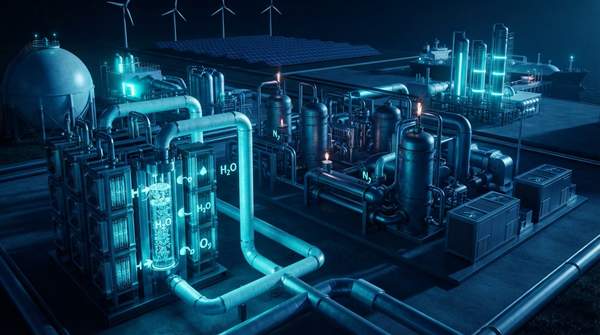
How Green Ammonia Is Made: Electrolysis, Haber-Bosch, and the Path to Cleaner Fertilizer and Shipping
Green ammonia is produced in two stages: first, hydrogen is split from water using renewable electricity via electrolysis, and second, this hydrogen reacts with nitrogen from the air in the Haber-Bosch process. This low-carbon method offers a cleaner alternative for fertilizer production and emerging zero-carbon fuel for shipping.
Oct 20, 2026 · 5 min read