There is no single "best" haptic technology for VR and AR — the right choice depends entirely on what your project must feel, how much power it can spend, and what form factor it must fit into. What the evidence does support is a clear set of trade-offs: vibrotactile feedback is the simple, established baseline for alerts and basic touch; pneumatic force feedback delivers realistic resistance for object manipulation at the cost of bulk and energy; and electrical muscle stimulation (EMS) can create strikingly realistic sensations like perceived weight, but demands careful control and attention to user comfort. I believe the most useful way to choose is a decision framework, and that is exactly what this article delivers below.
Understanding Haptic Feedback in VR/AR
Haptics technologies in AR and VR enable users to physically feel virtual objects, surfaces, and events within augmented environments, as Aarav Kumar explains in a 2025 overview of haptics applications. Through devices such as vests, gloves, ultrasound emitters, and controllers, users can experience more immersive and intuitive interactions with digital content.
Yet touch remains the weak link in otherwise mature VR stacks. A review of haptic sensing and feedback techniques published in PMC notes that visual, auditory, and olfactory feedback have been maturely applied in VR, while virtual tactile lags behind because it requires feedback interfaces that conform to skin — interfaces that must be flexible, high-resolution, and scalable. Existing techniques, including mechanical vibration, electrotactile feedback, and dielectric elastomer actuators, have enriched VR in immersive games, virtual communication, and teleoperated robotics, but none has solved the problem outright. That gap is why the choice among technology classes matters so much at the start of a project.
Vibrotactile Feedback: The Foundation of Touch
Mechanical vibration is the workhorse of haptics. According to the PMC review, mechanical vibrations aim to evoke the vibration-sensitive receptors in the skin, generating virtual haptic sensations directly on its surface. Vibration stimuli can be realized by pneumatic and magnetic actuators, which gives developers a range of implementation options within the same basic category.
Where does vibrotactile feedback fit? It is commonly integrated into gaming controllers and wearable devices for general haptic alerts and feedback — the applications where precise force rendering or complex tactile texture is not the primary goal. That is its strength and its ceiling. While effective for basic feedback, vibrotactile systems offer limited realism for complex physical interactions: you can signal that something happened, but you cannot easily make a user feel the weight of a virtual object or the resistance of a virtual surface. For many projects — notification cues, impact confirmation, rhythm games — that ceiling is perfectly acceptable, and the simplicity of the approach keeps cost and integration effort low.
Pneumatic Force Feedback: Simulating Physical Resistance
Pneumatic systems take a more direct route to physical realism: they use air pressure to generate resistance and force sensations. The PMC review describes pneumatic actuators facilitated with soft membranes that expand or contract depending on air inflation or deflation, producing either vibration stimuli or fingertip force feedback.
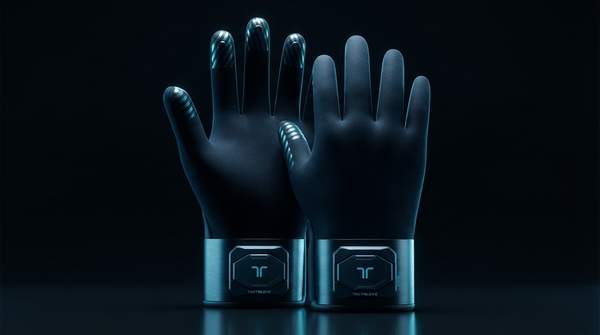
The research examples are compelling. Qi and colleagues reported a pneumatic glove built around two low-pressure modules — a PneuClutch and a PneuIndenter — actuated below 60 kPa. The glove was untethered and lightweight at 283 grams, and it let users sense kinesthetic and cutaneous feedback while touching, pressing, grasping, squeezing, and pulling virtual objects. The same team built a VR environment around the glove for object grasping and a complex archery game, showing its potential in medical training, industrial training, entertainment, and social interaction.
Miniaturization is progressing, too. Song and colleagues developed a pneumatic actuator for fingertip feedback in an integrated glove that used electrostatic force to generate internal air pressure instead of a bulky compressor, bringing the system down to 0.57 grams. The glove could provide realistic feedback when holding a virtual object. Still, pneumatic force feedback may face challenges with miniaturization and energy consumption compared to simpler haptics — the compressor-free design is notable precisely because the compressor problem is real.
Electrical Muscle Stimulation (EMS): Direct Muscle Engagement
EMS takes the most radical approach of the three: instead of pressing on the skin, it stimulates nerve endings or induces muscle contractions to create tactile sensations or simulate physical effort. This method directly engages the user's muscles for feedback, which opens a pathway to realism the other two cannot reach.
The clearest evidence comes from a 2025 study by Apostolos Vrontos, Reza Zolnouri, Alexander Mertens, Verena Nitsch, and Christopher Brandl, published in Virtual Reality, which investigated single-muscle (triceps brachii) versus dual-muscle (triceps brachii and extensor carpi ulnaris) EMS for weight perception. The study notes that EMS shows promise for augmenting weight perception in interactive systems, while a clear understanding of how different stimulation strategies affect both the intensity and realism of perceived weight has been lacking. Participants who reported an increase in perceived weight rated how realistic it felt on a 7-point Likert scale against the statement "The increase in perceived weight felt natural, as if caused by a real, physical change."
The qualification matters as much as the result: EMS realism depends on precise control and user comfort, because the technology involves direct muscle stimulation. The study's focus on validating that EMS increases perceived weight aligns with previous research highlighting EMS's potential for the sensation of increased weight — a narrow but powerful capability, not a general-purpose haptic channel.
Key Technical Constraints in Haptic System Development
Whichever technology you pick, the same systemic challenges apply. Market analysis from Market.us identifies the constraints that cut across the field: high implementation and component costs remain a key constraint, particularly for force-feedback systems and advanced actuators, limiting adoption in cost-sensitive segments. Energy consumption and power efficiency issues restrain mobile and wearable deployments because haptic modules add to device battery burdens. And technical integration challenges — miniaturization in compact form factors, latency in feedback, and standardization across devices and interfaces — are slowing market traction.
These constraints interact. A pneumatic glove that delivers immersive grasping feedback also carries actuator costs and an energy budget that a coin-cell-driven wearable cannot absorb. Latency compounds the problem: feedback that arrives late breaks the illusion of touch even when the actuator itself is capable. On the software side, the same market analysis reports that algorithms increasingly use AI and machine learning to refine vibration patterns and personalize feedback, with companies developing programmable haptic engines and open APIs — a trend that can offset hardware limits, but only after you have chosen hardware you can actually power and fit.
Haptic Technology Decision Framework for VR/AR Developers
The framework below maps the documented characteristics of the three technology classes to common application requirements. It is a recommendation boundary, not a ranking: read your project's top priority in the left column, then follow across to the technology whose documented strengths and constraints match it.
| Project priority | Vibrotactile | Pneumatic force feedback | EMS |
|---|---|---|---|
| Realism goal | Basic tactile sensations via vibration; limited to vibrational cues, not complex force or texture | Realistic resistance and force for touching, pressing, grasping, squeezing, and pulling virtual objects | Perceived weight increase rated as feeling natural; direct muscle engagement |
| Power and form factor | Lowest burden; fits controllers and compact wearables | Heavier and energy-hungry; research gloves range from 283 g to 0.57 g, showing an active miniaturization push | Requires precise stimulation control and attention to user comfort |
| Cost profile | Simplest, most established components | Force-feedback systems and advanced actuators carry the highest implementation and component costs | Specialized; comfort and control requirements add engineering cost |
| Best-fit use case | Gaming controllers and wearables for alerts and general feedback | Haptic gloves for object manipulation in medical training, industrial training, entertainment, and social interaction | Applications where simulating physical effort, such as virtual weight, is the goal |
How to use it: if your priority is a low-power mobile or controller experience, the documented constraints — battery burden, miniaturization, and cost of advanced actuators — point to vibrotactile feedback. If your priority is high realism for object manipulation in a training simulation, pneumatic gloves are the documented fit, provided you can absorb the energy and form-factor costs. If your priority is the specific sensation of physical effort such as weight, the EMS weight-perception research points that way, with the explicit caveat that comfort and precise stimulation control must be engineered in from the start.
Making an Informed Haptic Technology Choice
Developers should select a haptic technology by aligning its inherent capabilities and constraints — realism, latency, power, and cost — with the specific interaction goals and form factor of their VR/AR project. The evidence supports capability boundaries, not a universal winner: vibrotactile for basic feedback, pneumatic for realistic resistance, EMS for weight and muscle engagement.
The measurable indicator of a good choice is concrete: the project's haptic implementation successfully delivers the intended level of immersion and tactile feedback without exceeding power or latency budgets. Define that budget before selecting an actuator class, and test against it early — because every constraint documented here, from battery burden to feedback latency, gets harder to fix the later it is discovered.