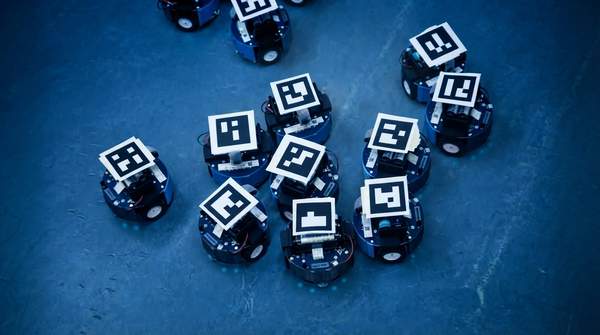
Swarm robotics replaces the single central brain of a traditional autonomous mobile robot fleet with intelligence distributed across the robots themselves, and that architectural change is what drives its two headline advantages in the warehouse: efficiency that holds up under congestion, and resilience that survives robot failures. Where a centralized controller must compute every movement and task assignment for the fleet, a swarm assigns each robot simple local rules, letting coordination emerge from neighbor-to-neighbor interaction. For logistics managers evaluating how to scale picking, sorting, and inventory operations, the distinction is not academic; it determines what happens on a busy floor when a unit fails or demand spikes.
Introduction to Swarm Robotics in Warehouses
The core idea is borrowed from nature: large numbers of simple devices solving problems that no single device could solve alone. Capitol Technology University's engineering blog describes the method as coordinating many simple devices through the same principles animals use in flocks and colonies, with warehouse floors cited alongside manufacturing and logistics as settings where scalability, adaptability, and resilience matter most. Conventional AMRs already handle material transport and order picking, as Mouser's coverage of autonomous systems notes, but they often follow fixed paths and depend on higher-level coordination. Swarm-capable robots change that equation by making local decisions and adapting on the fly, effectively turning the fleet into a distributed workforce rather than a set of endpoints reporting to one dispatcher.
Core Principles of Swarm Intelligence
Three principles define the approach. First, decentralized control: no single node holds the plan. A 2024 review of swarm robotics in logistics operations, published in Robotics Xplore, describes a decentralized control system in which several robots accomplish complex tasks through fundamental local interactions rather than commands from above. Second, local interaction: each robot senses and responds to its immediate neighbors and surroundings, not to a global map of the entire operation. Third, emergent behavior: useful fleet-level patterns, such as traffic that routes around congestion, arise from those simple individual rules without anyone explicitly programming the pattern.
The same review connects this shift directly to operational outcomes, stating that the change from centralized to decentralized control improves scalability, resilience, and adaptability, which contemporary logistics operations need. That causal link, from architecture to operating characteristics, is the analytical foundation for everything that follows.
Swarm Robotics vs. Centralized AMR Control: A Comparative Overview
The clearest way to see the difference is to hold both control models against the same warehouse functions. The table below contrasts a traditional centrally controlled AMR fleet with a swarm intelligence-based fleet across five operational factors. The centralized column reflects documented weaknesses: latency, single points of failure, and limited responsiveness to real-time disruptions, as identified in a 2025 multi-agent AI framework paper by Olasubomi Akanbi and colleagues in the International Journal of Scientific Research in Humanities and Social Sciences. The swarm column reflects the decentralized principles described above.
| Operational Factor | Traditional Centralized AMR Control | Swarm Intelligence-Based Control |
|---|---|---|
| Control Architecture | A central controller manages movements and tasks, which can create bottlenecks and single points of failure. | Intelligence is distributed across the fleet; individual robots make local decisions from simple rules and interactions, emphasizing decentralized control, local interaction, and emergent behavior. |
| Path Planning & Congestion | Struggles with latency and limited responsiveness to real-time disruptions, which can lead to bottlenecks. | Bio-inspired algorithms and self-organization support dynamic path planning and robust collision avoidance; complex collective behaviors emerge from simple individual robot rules. |
| Task Allocation | Often relies on predefined sequences of actions or coordinated control architectures, and can struggle with adaptive resource use in dynamic environments. | Enables adaptive task allocation in which multiple robots collaborate toward common goals. |
| Resilience to Failure | Presents single points of failure; if the central controller fails, the entire system can be interrupted. | Fault tolerance is enhanced; individual robots keep operating even if some units fail or communication is interrupted. |
| Scalability | Scaling adds load to the central controller, compounding latency and failure risk. | Adding robots adds capacity without a corresponding central bottleneck, supporting fleet growth and reassignment. |
Read together, the columns define a decision framework: the swarm model performs better precisely where warehouse conditions are hardest, namely traffic bottlenecks, robot failures, and the need to scale the fleet up or down quickly. Mouser's account of swarm-capable systems adds the operational texture: if one unit fails, others step in, idle robots can be reassigned instantly, and traffic bottlenecks can be avoided without human intervention, yielding a fault-tolerant, scalable system ready for unpredictable conditions.
Applications in Warehouse Operations
The 2024 logistics review maps the swarm approach onto specific warehouse functions: inventory management, order picking, sorting, and transportation. It describes a concrete pattern of use, in which a group of robots in a vast warehouse independently moves across the space, collects objects, and carries them to specific destinations. The claimed results follow from the architecture itself: robots cooperating to move items efficiently, maximize storage capacity, and improve task efficiency, while decreasing the need for human involvement, reducing mistakes, and enhancing overall effectiveness.
The picking example illustrates the mechanics. Instead of a dispatcher sequencing pick assignments for every robot, each unit reacts to what it can sense nearby: an open lane, an available workstation, a stalled neighbor. Task allocation adapts continuously as conditions change, which is what the review means by adaptive allocation toward common goals. Sorting and inventory management follow the same logic, with local decisions aggregating into fleet-level throughput.
Benefits for Efficiency and Resilience
The efficiency case rests on removing the central bottleneck from decision-making. Decentralized coordination through local interactions, as the multi-agent framework paper frames it, enables robust coordination and collective optimization without the latency that burdens centralized architectures as fleets grow. The resilience case is even sharper: because no single controller holds the plan, the failure of one robot, or even an interruption in fleet-wide communication, degrades performance only locally. Mouser's framing of the swarm as a distributed workforce captures the practical consequence: units step in for failed colleagues, and the operation continues.
Two caveats belong in any management-level assessment. The evidence base described here is conceptual and review-level, not a benchmark study of a named commercial deployment, so specific throughput percentages should not be inferred from these principles alone. And implementation details, such as particular communication protocols or optimization algorithms, sit below the level of this analysis; they are engineering questions that vary by vendor and site.
Embracing Swarm Intelligence for Future-Ready Warehouses
Logistics managers should consider adopting swarm robotics principles to enhance the efficiency, resilience, and scalability of their AMR fleets in dynamic warehouse environments. The comparison above shows why: centralized control concentrates risk and latency, while decentralized control distributes both decision-making and failure tolerance across the fleet. The measurable indicators to watch in any evaluation or pilot are increased throughput and reduced downtime in warehouse operations, alongside improved adaptability to changing demands and robot failures. A pilot that tracks those metrics against a centralized baseline, under real congestion and failure conditions, is the concrete next step the current evidence supports.
Sources
- HAL
- The Nature of Swarm Robotics: How New Engineering Methods Are Transforming the Robotics Field — Captechu
- How Robotic Swarms Are Advancing Tomorrow’s Autonomous Systems | — MOUSER
- A Multi-Agent AI Framework for Swarm Intelligence in Autonomous Mobile Robot (AMR) Fleet Coordination — International Journal of Scientific Research in Humanities and Social Sciences