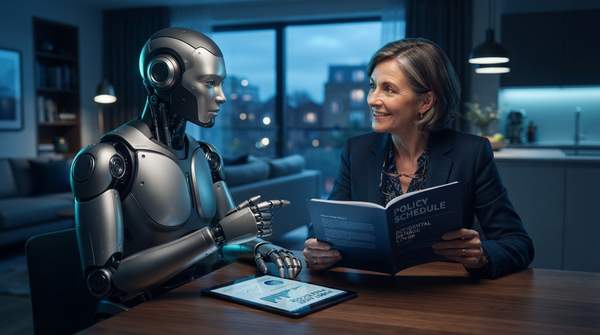
The UK now has its first insurance policy designed specifically for domestic humanoid robots, launched through a partnership between specialist insurer Adrian Flux and Texas-based underwriter Tokio Marine HCC International. The product covers four distinct areas: damage to and theft of the robot itself, sudden damage the machine causes to the home or belongings, personal liability if it injures someone or damages property, and emergency recovery or safe disablement after a malfunction. For early adopters, the significance is straightforward: a robot costing thousands of pounds carries asset, operational and liability risks that ordinary household policies were never designed to address.
The UK's First Domestic Humanoid Robot Insurance Policy
The two firms describe the product as the UK's first domestic humanoid robot household insurance policy, sold to British customers through Adrian Flux's home insurance range and underwritten by Tokio Marine HCC International. The launch is deliberately ahead of the market: domestic humanoid robots are expected to appear in UK homes from 2027, and demand has already emerged in the United States, where robotics and AI companies have released home humanoids with early models on open pre-order at around $20,000.
Stuart Heath, head of distribution, international at Tokio Marine HCC International, framed the move as a break from how insurers usually behave. "A robot that costs thousands of pounds is not something you want sitting outside your insurance policy," he said, adding that "insurance has traditionally reacted to rather than facilitated new markets and products." Gerry Bucke, general manager at Adrian Flux, said the goal was "to provide clarity on who is responsible if something goes wrong" as robots begin arriving in people's homes.
Understanding the Four Key Coverage Areas
According to the insurers' announcement, the policy is structured around four components, each answering a different question an owner might face. The first protects the machine as an asset. The second and third address what the machine does to its surroundings and to other people. The fourth deals with the scenario that most distinguishes a humanoid robot from a conventional appliance: a sudden or unforeseen malfunction that leaves it operating unpredictably in a lived-in space.
Adrian Flux has drawn a parallel with its driverless car policy launched in 2016, which Bucke said "will be updated as the technology and the risks evolve" — a signal that the insurer expects the coverage terms to develop alongside the technology rather than remaining fixed at launch.
Humanoid Robot Insurance: Coverage vs. Risk
The table below maps each announced coverage component to the specific category of risk it addresses, distinguishing asset risks, operational risks within the household, third-party liability risks, and malfunction hazards requiring intervention.
| Coverage Area | Specific Risks Addressed | Risk Category |
|---|---|---|
| Damage to and theft of the robot | Loss of a high-value asset — early US home humanoids are priced around $20,000 — through physical damage or theft | Asset risk |
| Sudden damage caused to the home or belongings | Accidental damage to the owner's property during robot operation inside the household | Operational risk |
| Personal liability | Injury to another person, or damage to their property, for which the owner could face claims | Third-party liability risk |
| Emergency recovery or safe disablement | A sudden or unforeseen malfunction that makes the robot a hazard requiring professional intervention | Malfunction hazard |
The structure shows why a standard home contents policy would struggle with this device class. A humanoid robot is simultaneously an expensive possession, a mobile agent operating autonomously among people and furniture, and a potential source of third-party claims — three risk profiles that normally sit in separate insurance products. The announcement indicates the policy appears to be the world's first that protects the home as well as the robot.
Why Specialized Insurance is a Market Enabler
The insurers position the product as proactive rather than reactive, intended to get ahead of an emerging market before the first UK deliveries arrive. That framing matters because adoption of any new device class depends on buyers being able to quantify and transfer the downside risks. A machine that moves around a home carrying out tasks introduces failure modes that static appliances do not have — The Register's coverage of the launch noted that as with anything AI-driven, "things can go horribly wrong" when automatons are roaming a home, and that such devices have even been labelled potential "botnets in physical form."
Heath's observation that insurance has traditionally reacted to rather than facilitated new markets identifies the gap this product fills. By making cover available before domestic humanoids reach UK households, the insurers are removing one barrier — uninsurable liability — ahead of the expected 2027 arrival, rather than waiting for claims to force the issue.
Implications for Early Adopters in the UK
For households considering a domestic humanoid, the policy changes the ownership calculation in three ways. First, the asset itself — potentially a five-figure purchase — can be protected against damage and theft. Second, the owner gains a defined answer to Bucke's question of "who is responsible if something goes wrong," covering both damage within the home and liability toward other people. Third, the emergency recovery provision acknowledges that a malfunctioning humanoid is not something an owner can simply switch off and forget.
Prospective buyers should note the limits of what has been announced. The public statements describe the coverage areas but not the full policy wording, so monetary limits, exclusions and precise definitions — including exactly what counts as a "sudden or unforeseen malfunction" — will only be answerable from the policy documents themselves. No pricing has been announced, and because the product is described as the first of its kind in the UK, there is no competing policy to compare it against.
Preparing for the Robotic Home: A Necessary Step
Early adopters of domestic humanoid robots in the UK should consider this specialized insurance policy as an essential component of ownership to mitigate significant financial and liability risks. The reasoning is evidence-bound: the insurers themselves state that a robot costing thousands of pounds should not sit outside insurance cover, and the policy's four components directly address the asset, household-damage, liability and malfunction risks that a high-value autonomous machine introduces into a home. The measurable indicator to watch is the availability and uptake of such specialized insurance policies, which will indicate increasing market maturity and consumer confidence in domestic humanoid robotics — a signal worth tracking as the expected 2027 arrival of domestic robots in UK homes approaches.
Sources
- ‘First’ insurance policy for domestic humanoid robots in the UK — Robotics & Automation News
- Domestic droid gone amok? Don't worry, you're covered — theregister