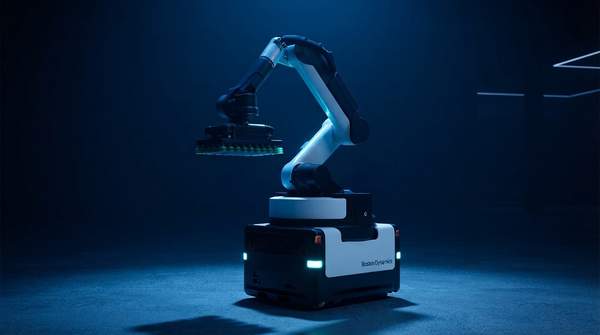
Boston Dynamics has launched the second generation of its autonomous trailer-unloading robot Stretch, rebuilt around a single operational goal: keeping the machine on the dock instead of in the repair bay. Announced on November 3, 2026, Stretch Gen 2 pairs an 81 percent reduction in internal cabling—about half a mile of wire removed—with continuous rotation joints, automotive-grade connectors and a modular design that cuts a full swerve drive replacement from roughly a full day to about an hour. What the company has not yet released are the numbers logistics managers need most: mean time between failures, mean time to repair, pricing and a shipping date.
Boston Dynamics Unveils Stretch Gen 2: A Focus on Uptime and Reliability
The redesign is grounded in field evidence rather than a clean-sheet engineering exercise. Boston Dynamics says its team analyzed data from more than 100000 operating hours and tens of millions of boxes that first-generation Stretch units had already unloaded, using that dataset to target the most common causes of unplanned downtime. The result, according to the company, is a robot hardened for durability with an updated modular architecture enabling "plug and play" part swaps.
The framing is explicitly commercial. "Our customers count on Stretch to keep freight moving, and every hour a robot sits idle is an hour of work that piles up on the dock," said Brian Donnelly, Vice President and General Manager of Logistics Robotics at Boston Dynamics. "With Gen 2, we focused on the things that actually took robots offline in the real world. We made it tougher, we made it simpler to service, and we made sure it keeps getting better long after it's deployed."
That last claim points to software as well as hardware: the company positions Gen 2 as a platform that improves after deployment. For warehouse operators, the significance is that the upgrade cycle targets the specific failure modes observed in production fleets, not laboratory conditions.
Engineering for Durability: Key Hardware Upgrades
The hardware changes cluster around three chronic weak points in mobile warehouse robots: wiring, joints and connectors. The cabling cut is the headline item. By removing 81 percent of internal cabling—roughly half a mile of wire—Boston Dynamics eliminated what it identifies as the biggest source of intermittent electrical faults, abrasion and connector failures. Fewer dynamic cables and complex harnesses mean fewer opportunities for the intermittent faults that are notoriously hard to diagnose on a live dock.
The joints received a structural rethink. New continuous rotation joints move beyond 360 degrees, so they no longer hit hard stops—a design change aimed at the mechanical stress that accumulated at those endpoints in the first generation. Connectors were upgraded to heavy-duty automotive-grade parts rated to withstand the vibration of rapid, high-torque box handling and travel over uneven floors.
The gripper was also revised, with new valve systems and more precise sensing intended to support faster, more reliable picks. Boston Dynamics also standardized its fasteners across the machine, reducing tool changes during service work—a small detail with a direct effect on wrench time.
Stretch Gen 2 Reliability Upgrades: A Comparative Overview
The table below maps each engineering change to the Gen 1 problem it addresses and the operational benefit Boston Dynamics claims, giving logistics managers a scannable framework for assessing the upgrade beyond a feature list.
| Component/System | Gen 1 Problem | Gen 2 Upgrade | Impact on Operations |
|---|---|---|---|
| Internal cabling | Extensive wiring was the biggest source of intermittent electrical faults, abrasion and connector failures | 81 percent of internal cabling removed—about half a mile of wire; dynamic cables and complex harnesses eliminated | Fewer intermittent faults and less wiring wear, supporting higher uptime |
| Joints | Hard stops at rotation limits caused mechanical stress | Continuous rotation joints moving beyond 360 degrees | Reduced mechanical wear and stress-related downtime |
| Connectors | Vibration from rapid box handling and uneven floors stressed connections | Heavy-duty automotive-grade connectors | Connections that hold up under high-torque handling and rough floors |
| Gripper | Pick speed and reliability limited by older valve and sensing systems | Revised valve systems and more precise sensing | Faster, more reliable grasping and placement |
| Swerve drive | Full replacement took roughly a full day | Modular "plug and play" design; standardized fasteners reduce tool changes | Complete swap in about one hour, sharply reducing repair downtime |
| Diagnostics | Routine work often required outside engineers | New onboard diagnostics | Customer maintenance staff can handle more routine service in-house |
Read together, the rows show a coherent strategy: remove failure opportunities (cabling, hard stops), harden what remains (connectors), and make whatever still fails fast to fix (swerve drive, diagnostics). The swerve drive figure is the one fully quantified repair-time claim in the announcement, and it is the clearest evidence that the redesign is aimed at wrench time, not just component life.
Streamlined Maintenance: Faster Repairs, Less Downtime
The maintenance story is where the announcement becomes concrete for operations teams. Boston Dynamics says a complete swerve drive swap—the wheel unit that moves the robot—now takes about one hour, compared with an entire day previously. That single change compresses what was a shift-consuming repair into a window that can plausibly fit inside a planned break or between trailer arrivals.
The shift is also organizational. New onboard diagnostics let a customer's own maintenance staff carry out more routine work without waiting for outside field engineers, according to reporting on the launch. For operators, that reduces dependence on vendor service schedules and travel time—often the dominant driver of real-world repair latency in dispersed warehouse networks.
Context from existing deployments suggests the stakes. DHL Group, which signed a memorandum of understanding with Boston Dynamics in May 2025 covering more than 1,000 additional units worldwide, has reported unloading rates of up to 700 cases an hour from its Stretch deployments. At that rate, a day-long swerve drive repair represents thousands of cases of lost throughput; an hour-long one changes the economics of keeping spare units versus spare parts.
Evaluating Stretch Gen 2: Unanswered Operational Questions
The announcement leaves the procurement picture incomplete. Boston Dynamics did not disclose pricing for Stretch Gen 2, a shipping date, or which customers will receive the first units. More significantly for fleet planning, no industry-standard reliability metrics accompany the launch: mean time between failures, mean time to repair across the full machine, and fleet-level availability figures are absent from the public materials.
Independent analysis of the launch flags further gaps. Sustained throughput by carton mix, trailer condition and multipick eligibility remains unspecified, as do power-related details behind shift-duration claims—battery duty cycle, degradation and charging cadence. Whether first-generation Stretch units can be upgraded to Gen 2 hardware, or whether existing fleets will diverge from new units, is also not addressed.
These gaps do not undermine the announced improvements, but they do mean the one-hour swerve drive figure cannot yet be extrapolated into a total-cost-of-ownership model. A single quantified repair time is not a maintenance profile.
Next Steps for Logistics Professionals: Assessing Stretch Gen 2's Full Potential
Logistics and automation professionals should prioritize inquiring about specific Mean Time Between Failures (MTBF) and Mean Time To Repair (MTTR) metrics, as well as detailed pricing and availability, to conduct a comprehensive operational assessment of Stretch Gen 2. The hardware direction is well-evidenced and internally consistent with the field data Boston Dynamics cites; the business case is not yet closable on public information alone.
The measurable indicator to watch is the release of official MTBF, MTTR, pricing, and shipping date information from Boston Dynamics or independent third-party evaluations. Until those figures arrive, the one-hour swerve drive swap stands as the announcement's single hardest number—and the anchor point against which any subsequent reliability claims should be checked.
Sources
- Boston Dynamics Launches Next Generation Stretch Robot
- Boston Dynamics' Stretch Gen 2 cuts robot repair time to just one hour — Interesting Engineering
- Boston Dynamics launches next-generation Stretch robot with major reliability upgrades — Robotics & Automation News
- Boston Dynamics launches Stretch Gen 2, rebuilt from 100,000 hours of field data — AUTONOMOUS
- Boston Dynamics Rebuilds Stretch Gen 2 to Unload 1,000 Boxes per Hour — AlphaSignal