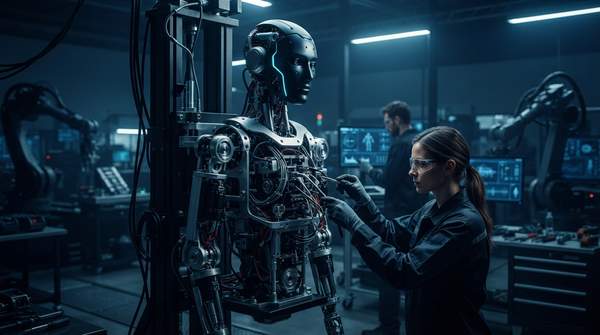
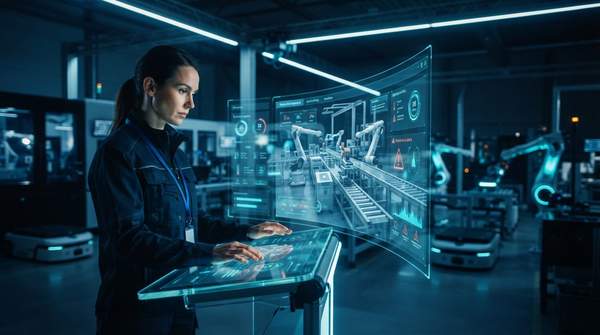
In shared space human-robot collaboration, the three most frequently measured operator states are not productivity metrics, but trust, cognitive workload, and anxiety, according to reports from pmc.ncbi.nlm.nih.gov and Frontiersin. A focus on subjective human experience, rather than mere output, exposes a critical underlying tension in the pursuit of advanced robotics for worker well-being. Operators are at risk of losing situation awareness of the cobot, increasing the chance of collision—a stark reminder that 'progress' can be perilous if human factors are ignored.
While automation promises streamlined operations and increased efficiency, it often introduces significant human challenges such as heightened anxiety and cognitive overload for operators. The introduction of significant human challenges such as heightened anxiety and cognitive overload for operators creates a workforce more anxious than efficient, actively undermining automation's potential for productivity gains.
Companies that fail to integrate human-centric design into their automation strategies risk not only worker dissatisfaction and safety issues but also suboptimal system performance and missed innovation opportunities. Failure to integrate human-centric design into automation strategies isn't just a moral failing; it's a strategic blunder, actively sabotaging the very productivity and innovation automation promises.
The Pragmatic Imperative: How Human Factors Drive Performance
Human factors have been shown to impact system efficiency and response time, collaborative performance and quality of work, and operator utilization strategy, as reported by Frontiersin. The impacts of human factors extend beyond mere comfort, directly affecting the operational effectiveness of automated systems. Neglecting these human elements can lead to systems that do not meet their intended performance targets, regardless of their technical sophistication.
Subjective questionnaires are the most common method for quantifying operator states, except for fatigue, where electromyography is more common, according to pmc.ncbi.nlm.nih.gov and www.frontiersin.org. Reliance on qualitative data for measuring crucial human states like trust and cognitive load exposes a critical gap. It's a glaring oversight: companies prioritizing purely technical efficiency over human-centric design are building systems destined to underperform and alienate their workforce.
Beyond Job Loss: Automation's Evolving Role in Labor
Physical tasks in hospitality may be harder to automate than cognitive ones, potentially making low-paid housekeepers safer from job replacement than high-paid marketing managers, according to Hospitality Net. The finding that physical tasks in hospitality may be harder to automate than cognitive ones shatters the common narrative that automation primarily threatens low-wage roles, revealing a far more complex impact on the labor market.
The future of hospitality labor involves differently assembled teams rather than simply fewer people, Hospitality Net states. The statement that the future of hospitality labor involves differently assembled teams rather than simply fewer people dismantles the oversimplified narrative around automation-driven job loss. Human roles will evolve into new, collaborative structures, not simply disappear, especially in tasks requiring complex physical interaction. The surprising resilience of physical, low-wage jobs against automation, contrasted with the vulnerability of cognitive roles, reveals a critical misalignment: current automation strategies may exacerbate white-collar job insecurity while public perception remains fixated on the factory floor.
The Strategic Imperative: Redesigning Work for Simultaneous Gains
The central managerial question is how to redesign work so that automation technologies improve productivity, service quality, and employee well-being simultaneously, according to Hospitality Net. The central managerial question of how to redesign work so that automation technologies improve productivity, service quality, and employee well-being simultaneously isn't merely about introducing new machines; it's about a fundamental rethinking of work processes. It demands an integrated approach, considering human and technological factors in tandem, or risk squandering automation's true potential.
A paper proposes a framework for designing human-centric automation solutions, drawing on empirical evidence from human-computer interaction research and case studies, as detailed by Arxiv. The paper proposing a framework for designing human-centric automation solutions proves the challenge isn't just implementing technology, but fundamentally rethinking work design through proven frameworks to leverage automation for holistic improvement. The continued reliance on subjective questionnaires for measuring human states in automation, despite the known impact of human factors on system efficiency, exposes a critical gap in objective feedback loops, preventing truly optimized human-automation systems.
Unlocking Potential: The Broader Benefits of Human-Centered Automation
Human-centered automation can benefit productivity, innovation, and democratize access to automation technologies, according to arxiv.org. Human-centered automation isn't a compromise; it's the only pathway to superior outcomes across the board. It extends beyond immediate operational gains, fostering a more inclusive and innovative technological landscape that truly serves humanity.
Integrating worker well-being and capabilities into system design unlocks broader societal benefits. Integrating worker well-being and capabilities into system design demands that advancements in robotics serve humanity, creating environments where collaboration enhances both output and job satisfaction. By Q3 2026, industries must adopt frameworks for human-centric automation, or risk seeing their investments yield diminished returns and increased operational friction, particularly in sectors like manufacturing and healthcare where human-robot interaction is critical.